Pig: Blockchain State Channel Game
Master’s thesis project on using state channels to make two-player blockchain games practical through off-chain coordination.
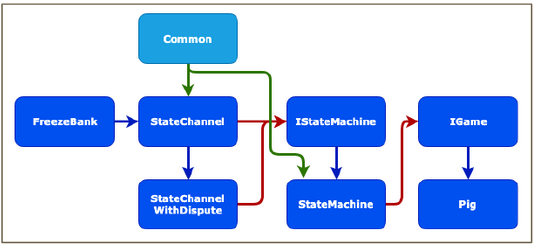
My master’s thesis used the dice game Pig as a concrete way to study state channels for Ethereum. The real subject was the coordination protocol behind the game: how to let two players exchange signed state updates off-chain and only fall back to the blockchain when necessary.
How it works
Two players open a channel by locking funds in an on-chain contract. From there, the match progresses through signed off-chain messages that update the shared game state without paying on-chain costs turn by turn. Only settlement, or a dispute, requires direct blockchain interaction.
That makes the project a Layer 2 prototype for a narrow but meaningful class of applications: two-player games where latency and transaction cost would otherwise make the experience unusable.
Key challenges
- Dispute resolution: designing challenge logic for the case where one player stops cooperating or disagrees on the latest state.
- Randomness: handling dice rolls in a way that works inside a blockchain-constrained architecture without relying on a trivial trusted source.
- Protocol design: keeping the implementation modular enough that the same state-channel structure could support more than one game.
The thesis also compared the state-channel approach against a fully on-chain baseline on Ropsten-era infrastructure, which was the practical validation point: fewer on-chain interactions, lower cost, and a more workable interaction model.
The communication layer behind that flow became the companion project Ethereum Data Channel, which handled peer-to-peer message exchange between participants.